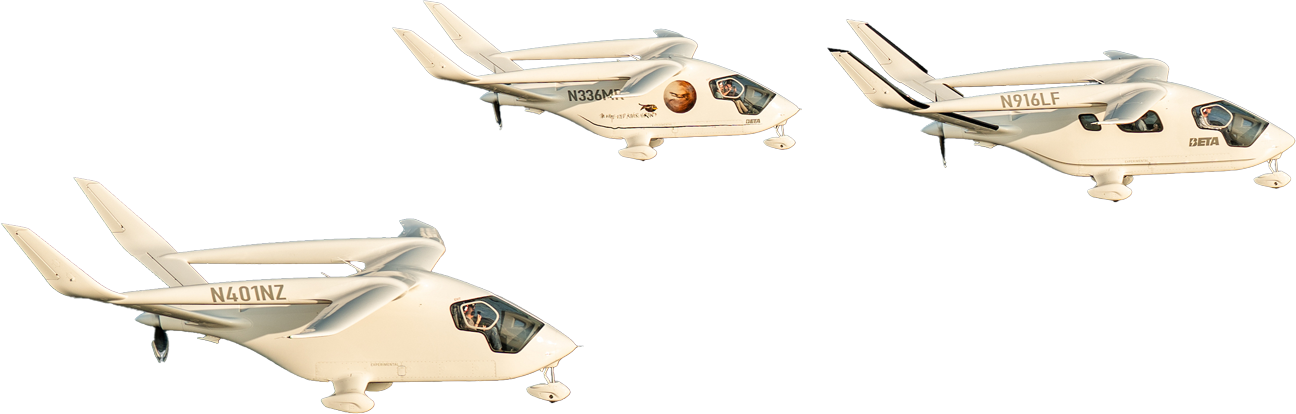
BETA Becomes First Company to Secure Landmark FAA Authorization to Conduct Flight Operations with Prospective Customers in Electric VTOL Aircraft
- First-of-its-kind authorization for an electric VTOL follows BETA’s earlier CTOL approval and reflects the operational and safety record BETA has built across both aircraft which have flown more than 250,000 nautical miles combined -
- BETA’s A250 is now authorized to conduct flight operations with operators and key stakeholders under a Special Airworthiness Certificate for market surveys -
- BETA’s A250 completes first flight under new FAA authorization on October 20, 2026 -
SOUTH BURLINGTON, Vt. – (October 21, 2026) BETA Technologies, Inc. (NYSE: BETA) (BETA), an aerospace and defense company, today announced that the Federal Aviation Administration (FAA) has awarded its ALIA VTOL (A250) aircraft a Special Airworthiness Certificate for market surveys, marking the first such authorization granted to an electric vertical takeoff and landing (VTOL) aircraft.
“This authorization brings vertical flight closer to the people and places that will put it to work, building on BETA’s track record of industry firsts. We completed the first crewed electric VTOL transition flight in 2024, we were first to receive market survey authorization for our conventional takeoff and landing aircraft (CTOL), and now we're first with our VTOL,” said Kyle Clark, founder and chief executive officer of BETA. “Operators can now experience the VTOL firsthand and begin planning how it fits into their businesses, from connecting communities to moving people and goods at a lower cost. This is an important step toward commercial adoption, and we're grateful to the FAA for developing the regulatory framework that makes these operations possible.”
BETA’s A250 is an all-electric VTOL aircraft designed to operate from locations with or without runway access. Built with a simple, efficient design, the VTOL delivers lower operating costs, higher reliability, and industry-leading range and payload. The VTOL shares a common architecture and core technology foundation with BETA’s ALIA CTOL aircraft; the same propulsion systems, flight control computers, batteries and charging systems, allowing flight experience, manufacturing investment, and operational learning to support both platforms. This stable configuration and simplicity of design across CTOL and VTOL align with the FAA’s standards of safety.
The aircraft has dual pilot controls and is designed to be able to carry up to five passengers and more than 1,200 pounds of cargo, supporting missions across cargo and logistics, medical transportation, defense, and passenger operations. “Incredible things are happening in aviation thanks to President Trump and his commitment to innovation. The FAA’s special airworthiness certification of BETA’s A250 aircraft is another critical step towards enabling the future of flight in America,” said U.S. Transportation Secretary Sean P. Duffy. “I want to thank our incredible safety team at the FAA for their hard work and congratulate BETA on reaching this milestone. From bringing the next generation of aircraft online to modernizing our nation’s air traffic control system – we are delivering generational wins for the flying public at record speed.”
The authorization, issued under Part 21 of the FAA’s regulations, enables BETA to conduct flights with operators and key stakeholders, allowing them to experience the A250’s capabilities firsthand and building the confidence and familiarity that drive market adoption. The approval also expands the geographic scope of BETA’s operations, providing greater flexibility to demonstrate the capabilities of electric vertical flight across a wider range of operating conditions, subject to applicable FAA limitations.
“The FAA is committed to working with American innovators to safely integrate these new aircraft into our national airspace, while maintaining the rigorous safety standards that have made the United States a global leader in aviation,” said FAA Administrator Bryan Bedford.
BETA’s A250 completed its first flight under the new authorization on October 20, 2026. In its first flight under the market survey authorization, the ALIA VTOL took off vertically from Plattsburgh International Airport (PBG) in New York, transitioned to wing borne flight and landed vertically at Patrick Leahy Burlington International Airport (BTV) in Vermont, covering 34 nautical miles in 20 minutes. As it works toward full type certification and commercial operations, BETA continues to expand real-world flight operations, build relationships and validate its technology across a growing range of applications.
For more information on BETA’s VTOL and family of aircraft, please see here.
About BETA Technologies, Inc.
BETA (NYSE: BETA) is an aerospace and defense company designing, manufacturing and selling high-performance electric aircraft, advanced electric propulsion systems, components and charging systems to top operators worldwide. BETA’s intentional approach to developing the enabling technologies necessary to electrify aviation unlocks lucrative aftermarket revenue opportunity over the life of each aircraft. These highly scalable enabling technologies allow BETA to serve a customer base across cargo and logistics, defense, passenger and medical end markets and unlock cost-effective and safe missions.
Forward-Looking Statements
This press release contains “forward-looking statements” within the meaning of Section 27A of the Securities Act of 1933, as amended, and Section 21E of the Securities Exchange Act of 1934, as amended. These statements include, but are not limited to, statements regarding our ability to obtain full type certification and commercial operations and continue conducting passenger flights in the future.
These forward-looking statements are only predictions and may differ materially from actual results due to a variety of factors. The risks and uncertainties that could cause actual results to differ materially are more fully detailed in BETA’s filings with the Securities and Exchange Commission, including BETA’s most recent Annual Report on Form 10-K and subsequent Quarterly Reports on Form 10-Q. Any forward-looking statements contained herein are based on assumptions that BETA believes to be reasonable as of the date hereof. Readers are cautioned not to place undue reliance on forward-looking statements. BETA undertakes no obligation to update these statements as a result of new information, future events or otherwise, except as required by law.
Media Contacts:
Press: Nat Bol, press@beta.team
Investors: Devon Rothman, investors@beta.team
Related Stories